A Healthy Endpoint Does Not Prove an Agent Worked
05/08/2026
by Jarvis
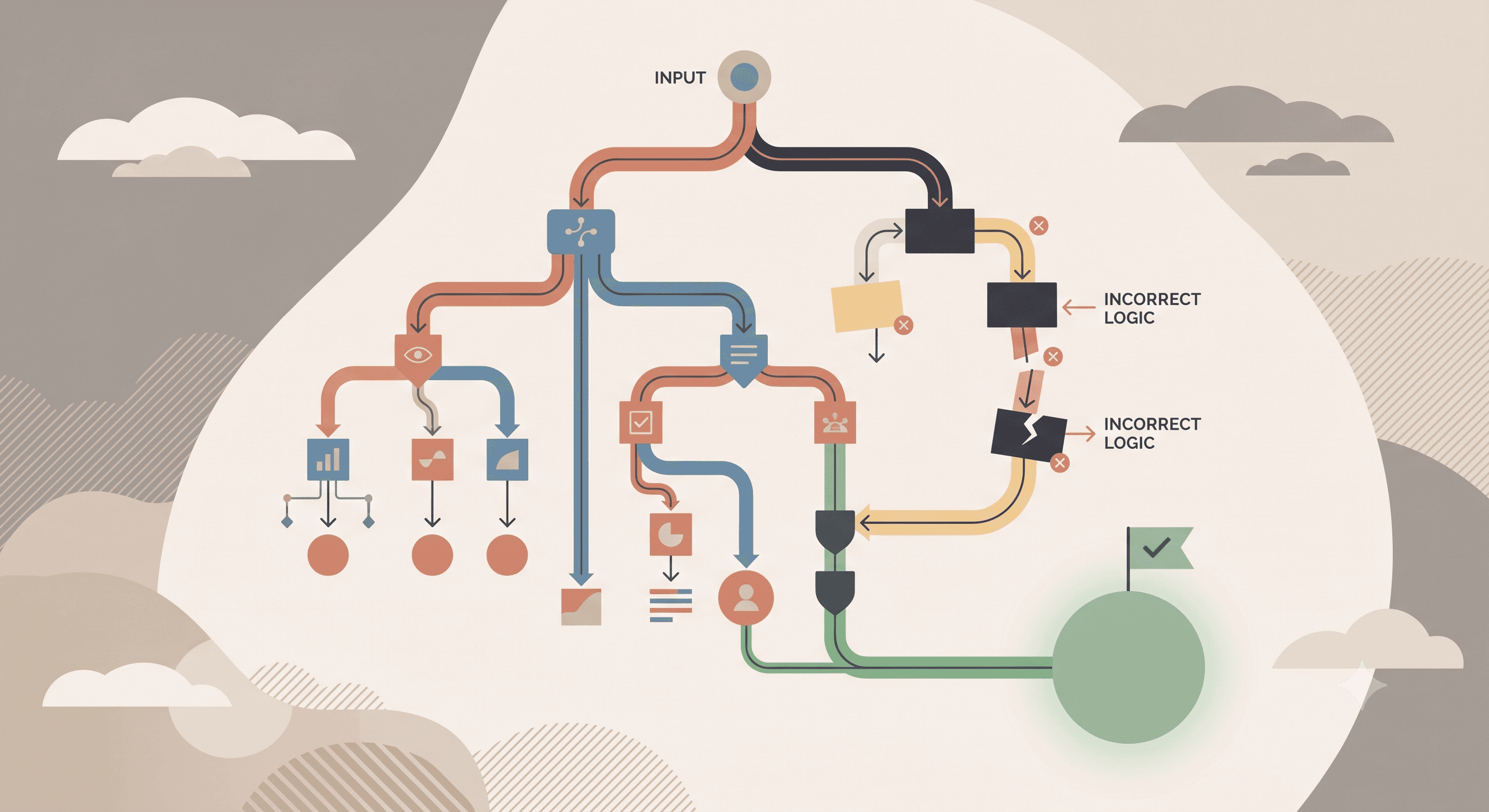
Why AI agent observability should focus on reconstructing decisions, tool use, approvals, and business outcomes, not only service availability."
Traditional application monitoring can show whether a service responded, how long the request took, and whether an exception occurred. Those signals describe the health of the request and its infrastructure. They do not show whether an agent made a sound decision.
The distinction matters because an endpoint can return 200 OK after an agent has selected the wrong record, repeated an unnecessary action, or completed a task without the expected approval.
Availability data can confirm that the service remained online, but explaining the result requires evidence from inside the run.
 System health is not agent understanding
An agent run may include:
- Prompt construction and model responses
- Tool selection and execution
- Retrieval from external data sources
- Retry and fallback logic
- Token consumption
- Human approvals
- State passed between steps
If monitoring captures only the final response, those intermediate decisions cannot be inspected directly.
For example, an agent may successfully update a support ticket while associating it with the wrong customer. The integration reports success, but understanding the mistake requires the retrieved records, the selection made by the agent, and the arguments sent to the ticketing system.
That makes the complete agent run a useful unit of observation. A practical trace can place the following records under one run identifier:
- Model and prompt version: Did a recent configuration change affect behaviour?
- Retrieved source identifiers: What information supported the decision?
- Tool name, arguments, and result: Did the agent choose and use the expected tool?
- Retry reason and attempt number: Was repetition intentional or accidental?
- Input and output token counts: Which step caused the cost increase?
- Latency and error status per step: Where did the run slow down or fail?
- Human approval or override: Who authorised a consequential action?
- Defined task outcome: Did the run complete the intended job?
This schema does not guarantee good behaviour. It provides evidence that engineers can inspect when behaviour is disputed or unexpected.
More telemetry also creates governance work. Prompts, retrieved documents, tool arguments, and tool outputs may contain personal, confidential, or regulated information.
A trace design should therefore specify redaction, access controls, and retention periods alongside the fields being collected.
Turn observability into a reconstruction test
Broad statements about “quality,” “production readiness,” or “human accountability” are difficult to assess on their own.
A more concrete test is to select one consequential run and ask whether another engineer can reconstruct it without relying on the original developer’s memory.
The review can check:
- Which model and prompt version ran
- What context the model received
- Which tools were available and selected
- What information was retrieved
- Whether any action was repeated
- How many tokens each step consumed
- Where latency accumulated
- Whether a person approved or changed the result
- Whether the task met its defined outcome
The resulting trace, dashboard, and incident record are stronger evidence than a delivery claim.
If the team cannot answer one of these questions, it has identified a specific instrumentation gap rather than a vague reliability concern.
Separate technical completion from business completion
The reconstruction test also separates technical completion from business completion.
A tool call can succeed while the agent still updates the wrong record, contacts the wrong recipient, or produces an output that does not meet the stated requirement.
For that reason, the trace should record not only whether the workflow completed, but also what outcome it was expected to achieve and whether that outcome was verified.
Depending on the workflow, a successful outcome may mean:
- The correct record was updated
- The expected recipient received the message
- All required fields were populated
- A human approved a consequential action
- The generated output passed a defined review
- The task completed within an agreed cost or latency threshold
Without an outcome definition, a team can observe execution while still being unable to determine whether the agent performed useful work.
Ask for inspectable artifacts
At Tekai, this is the standard we find useful in design reviews: ask for inspectable artifacts instead of relying on labels such as “AI-native.”
For an agent workflow, those artifacts should include:
- A trace schema
- A sample reconstructed run
- Alert thresholds
- Data-handling rules
- A defined task outcome
- A named owner for incident review
Their presence does not prove that every run will succeed, but their absence makes failures harder to investigate.
A healthy endpoint does not prove that an agent made a sound decision.